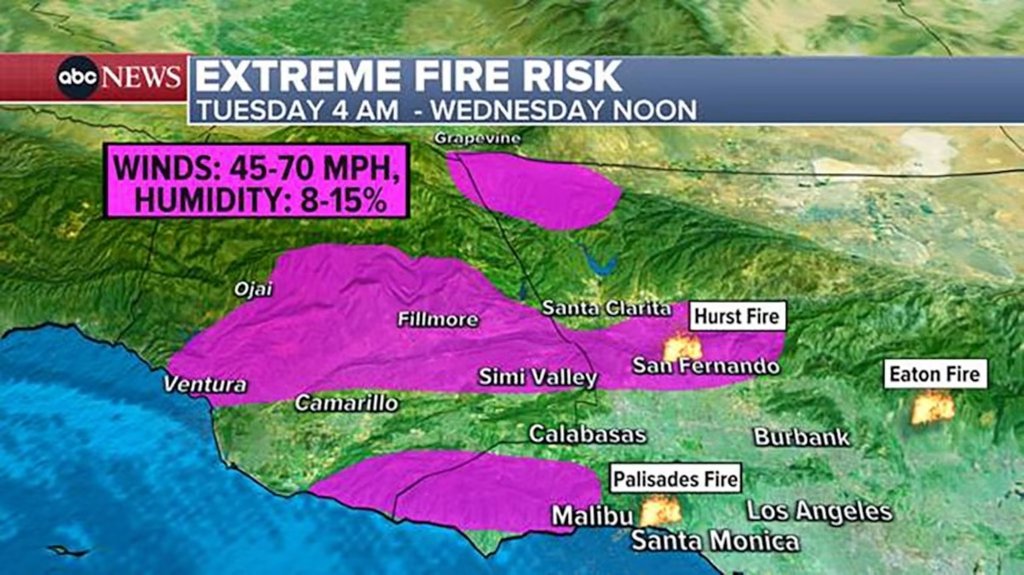
Let me start with the honest part: buying a home in a Ventura County fire zone in 2026 is more complicated than it was three years ago, and pretending otherwise doesn’t help anyone. The Mountain Fire reminded everyone in Santa Paula and Fillmore in November 2024 that this isn’t an abstract risk. The L.A. fires in January 2025 reset the entire California insurance market in ways that ripple straight into our county. And the updated CAL FIRE hazard maps that took effect last summer put a lot more homes inside the “High” and “Very High” lines than were there a year ago.
I’m not here to talk anyone out of buying a fire zone home. Some of the most beautiful properties in Ventura County — in Ojai, in the Thousand Oaks hills, in upper Ventura, in the Camarillo and Santa Paula foothills — sit inside those zones. People buy them every week, insure them, and live in them safely for decades. The job is to go in with clear eyes, the right paperwork in hand, and an offer that protects you if the insurance numbers don’t pencil.
Here’s what every Ventura County buyer should know before they fall in love with a hillside view.
This guide is general information, not legal, insurance, or tax advice. Always work with a licensed insurance broker and your real estate attorney on the specifics of any property.

When most people say “fire zone,” they’re talking about a Fire Hazard Severity Zone (FHSZ). CAL FIRE maps these zones based on terrain, vegetation, weather patterns, fire history, and ember exposure. There are three categories: Moderate, High, and Very High.
Ventura County’s maps came out in two phases. The State Responsibility Area (SRA) maps took effect April 1, 2024. The Local Responsibility Area (LRA) maps — which cover incorporated cities like Ventura, Camarillo, Ojai, Thousand Oaks, Moorpark, and Simi Valley — were adopted by city ordinances around July 2025. They’re the first major revision in over a decade and they reflect new science on how embers travel, how fast flames spread on slopes, and how dense vegetation behaves.
You can look up any specific property on the CAL FIRE FHSZ Viewer. If a property sits inside a High or Very High zone — in either an SRA or LRA — California law treats it differently when it sells.

This is the part of fire zone home buying that catches more people off guard than anything else in 2026.
Between 2021 and 2026, California homeowners insurance carriers non-renewed close to 400,000 policies, with the heaviest concentration in fire-prone ZIP codes. State Farm and Allstate paused new policies in much of the state. Farmers pulled back, then partially returned. Premiums in fire-exposed neighborhoods went up 30%, 50%, sometimes 100% over a few years. California FAIR Plan enrollment — the state’s insurer of last resort — grew by 43% between fall 2024 and the end of 2025.
The good news in 2026: Commissioner Lara’s Sustainable Insurance Strategy is now in effect. Carriers using forward-looking catastrophe models have to commit to writing policies in fire-distressed areas covering at least 85% of their statewide market share. Nine major carriers — Farmers, Mercury, CSAA, USAA, Travelers, AAA SoCal, Horace Mann, Pacific Specialty, and California Casualty — have publicly committed to staying and growing in California. Mitigation credits of 5% to 15% are now mandated for verified home hardening and defensible space work.
The not-yet-good news: those reforms will take 2026 and 2027 to fully unwind. In the meantime, insurance is the single largest practical hurdle to buying a fire zone home, and you should treat it that way.
Don’t rely on online quote tools. Forget what the seller is paying — their rate was locked years ago. Get a licensed broker who writes coverage in Ventura County and have them shop a real quote in your name on the specific property, ideally before you go into escrow, or in the first few days if you can’t.
What you’re trying to find out:
The order of those options matters because each one is more expensive and more limited than the one before.
FAIR Plan is fire-only, with limited additional perils. It doesn’t cover liability, theft, water damage, or most of what a normal homeowners policy covers. To get a full coverage stack on a FAIR Plan property, most buyers add a separate DIC policy through a private carrier. The combined cost of FAIR Plan plus DIC on a high-end Ojai or Thousand Oaks hillside home in 2026 can run $8,000–$20,000+ a year. Plan for that number, not a number from before the fires.
If the home you’re buying sits in a High or Very High FHSZ, California’s AB 38 disclosure law kicks in. Sellers have to give you a stack of paperwork before close of escrow. Here’s what should be in that stack.
The seller has to provide an inspection report showing the property complies with Public Resources Code Section 4291 — the state defensible space requirement. The inspection has to be current (within six months of the contract date). It can come from CAL FIRE, the local fire agency, or a qualified non-profit. The Ventura County Fire Department handles these for most properties in our county.
If the seller can’t get the inspection done in time, the law lets you and the seller sign a written agreement that you’ll get the inspection and bring the property into compliance within one year of closing. Post-2025, I’m seeing more buyers refuse this transfer — they want the inspection and any required cleanup done before they close, not after. That’s a reasonable position and one I’d push for in most cases.
The California Association of Realtors updated this form in June 2025, and it’s now substantially more detailed than the original 2021 version. The seller has to disclose:
This is a disclosure form, not a pass/fail certificate. The seller isn’t required to actually do the retrofits. They are required to tell you the truth about what has and hasn’t been done. Read it carefully. Properties with most or all hardening features in place will insure more easily and at lower rates than properties with none.
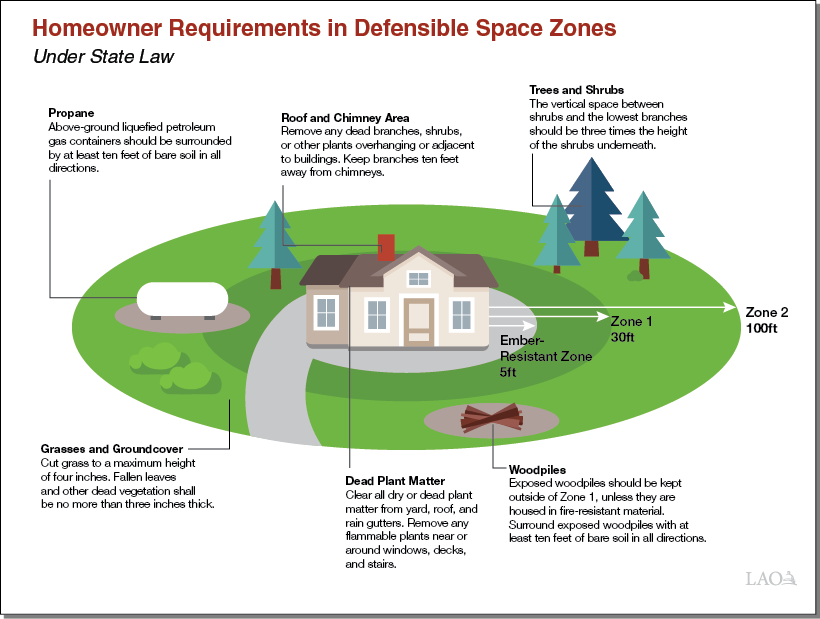
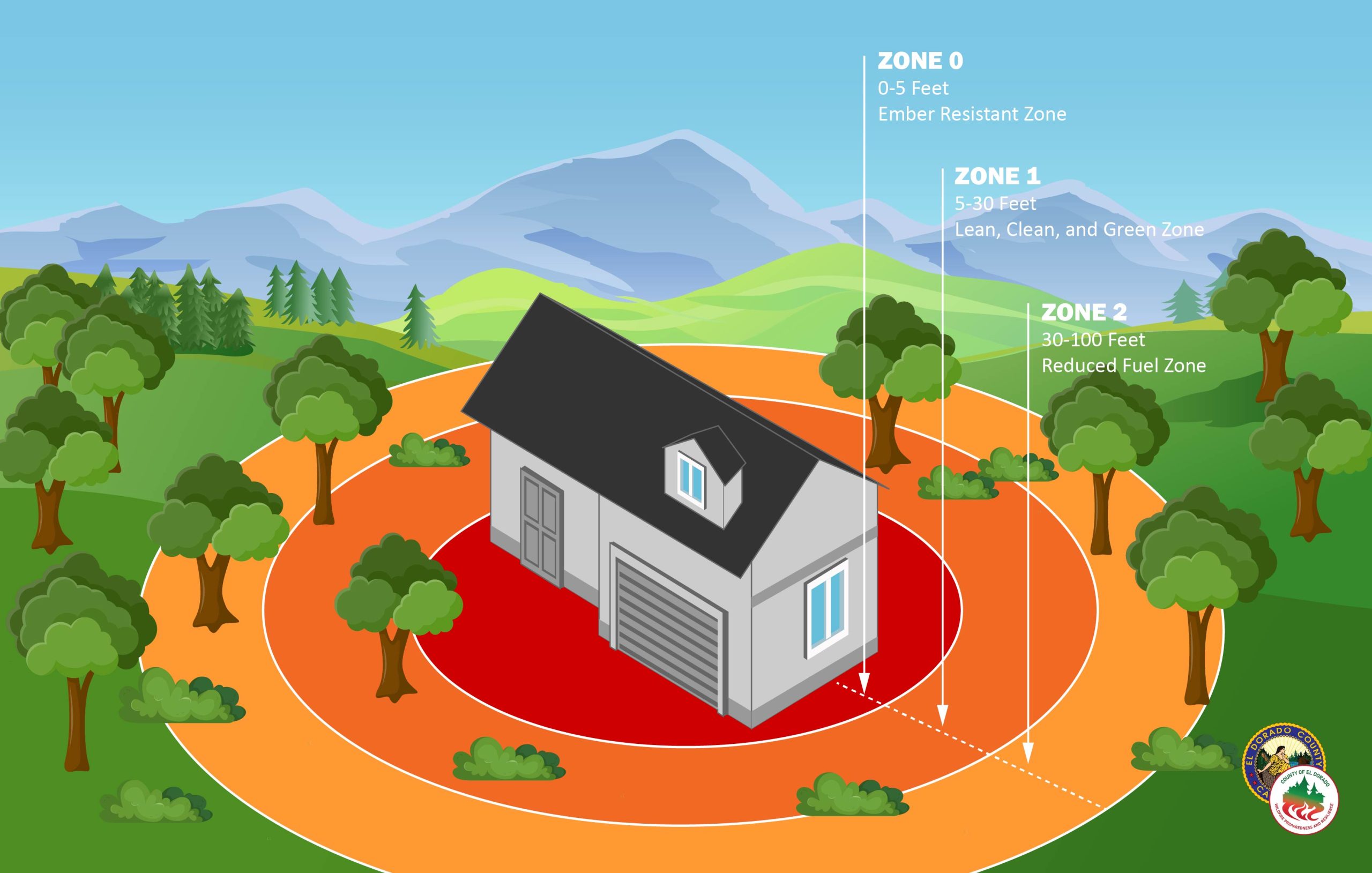
California defensible space rules carve the area around your home into three zones. When you’re walking a property, mentally measure these.
This is the ember-resistant zone. Nothing combustible belongs inside it: no bark mulch, no firewood stacks, no wooden lattice, no plastic deck furniture pushed against the siding, no dead leaves, no overhanging branches. The current standard pushes hard on this zone because embers landing within five feet of the house cause most ignitions. Gravel, decomposed granite, concrete, or stone is the preferred ground cover.
The “lean, clean, and green” zone. Grass kept under four inches. Tree limbs pruned at least six feet off the ground. No “ladder fuels” — meaning no shrubs growing under trees that let fire climb. Spacing between shrubs and trees so flames can’t jump.
Reduced fuel zone. Annual grasses cut. Dead trees and brush removed. Spacing between mature trees.
If the property runs up against open hillside, vegetation management often has to extend further than 100 feet under local rules. The Ventura County Fire Department can clarify what applies to a specific parcel.
For any fire zone home, the standard home inspection isn’t enough. Build in extra contingencies for these:
Even with the seller’s AB 38 inspection in hand, I usually recommend buyers schedule their own walk-through with a defensible space inspector during the contingency period. You’re not catching the seller in anything — you’re confirming that the property still complies, that the vegetation hasn’t grown back in, and that you understand what year-round maintenance will look like.
The two ember-entry points that ignite the most homes are roofs (especially older wood shake) and vents. Have your home inspector specifically document roof age, material, and condition. Confirm that attic and crawlspace vents have 1/8-inch ember-resistant mesh.
If the property has significant mature trees — common in Ojai, the older neighborhoods of Ventura, and the hillside parts of Thousand Oaks — pay for an arborist’s report. Tree health, species, distance to structures, and removal cost can all matter to your decision and to your insurance.
If you can negotiate it, build in an insurance contingency: the deal is contingent on you obtaining homeowners coverage at a premium under a defined threshold within a defined timeframe. Sellers will push back on this in competitive markets, but in 2026 it’s a reasonable ask, and a lot of fire zone listings are accepting it.
I’ve seen the same handful of mistakes enough times to call them patterns:
By the time you find out the policy will cost three times what the seller is paying, you’ve already spent money on inspections and emotional energy on the house. Pull the quote in week one.
The seller’s policy was likely written and rated years ago. It tells you almost nothing about what a new policy will cost you, today, on the same property. New money is priced at new risk.
The fire hardening disclosure is one of the most useful documents in a fire zone transaction, and a lot of buyers skim past it. Read every box. It tells you exactly what the home has been retrofitted to handle and what it hasn’t.
In some communities, the HOA maintains common-area vegetation. In most, the homeowner is on the hook for the full 100 feet around their structure. Confirm where the line falls before you assume.
If there’s one way in and one way out, that’s a serious risk factor. Always know the second route. If there isn’t one, that’s part of your decision.
A few things I do differently when a client is looking at a property inside a High or Very High zone:
This same focus on documentation, disclosures, and protective contingencies is how I approach trust and probate purchases and divorce-related real estate — transactions where what’s in the paperwork matters as much as the property itself.
A quick orientation, by area:
The right move on any specific property is to look it up on the FHSZ Viewer and have a conversation with an insurance broker before you go too far. I’m happy to make the broker introduction.
A checklist I walk buyers through:
If the seller’s agent can’t answer most of these promptly, treat that as information too.
In most cases, yes — though the path varies. For some properties, an admitted carrier will write coverage, especially if the home has been hardened and defensible space is documented. For others, you’ll go through a non-admitted (surplus lines) carrier. For the most exposed properties, you’ll need a California FAIR Plan policy combined with a Difference in Conditions (DIC) wrap. Get the quote before you write the offer.
Almost never. FAIR Plan covers fire and a handful of other named perils, but it doesn’t cover liability, theft, water damage, or most of what a standard homeowners policy includes. Lenders typically require a full coverage stack, which usually means pairing FAIR Plan with a DIC policy from a private carrier.
The designation itself doesn’t change the appraised value, but the insurance reality can. Lenders require proof of homeowners insurance before they fund the loan. If you can’t bind a policy that meets the lender’s requirements, you can’t close. That’s the most common way fire zone deals fall apart in 2026 — not on appraisal, on insurance.
Not in any practical sense. CAL FIRE determines SRA designations, and the State Fire Marshal recommends LRA designations. Local agencies can add to or increase the designations on the maps; they can’t reduce them or remove parcels. The maps are based on terrain, vegetation, and fire science — not subject to property-level appeal.
WUI is the area where developed neighborhoods meet wildland vegetation. Most fire zone homes in Ventura County sit in or near the WUI. Since 2008, California has required new construction in High and Very High FHSZ areas to follow Chapter 7A of the California Building Code — the WUI building standards covering ignition-resistant materials, ember-resistant vents, tempered glass, and enclosed eaves. Homes built before 2008 generally weren’t required to meet these standards, which is why home hardening retrofits matter so much in older Ventura County neighborhoods.
That’s a personal decision, and I’d never push someone either way. Plenty of Ventura County buyers make a thoughtful, eyes-open choice to live in a fire zone — for the views, the lot sizes, the quiet, the proximity to open space — and live in those homes safely for decades. Plenty of others decide the insurance math, the annual brush clearing, and the evacuation risk aren’t worth it. Both decisions are valid. The wrong decision is making either one without the data.
The buyers who come out of these transactions happy almost always do the same things: they get a real insurance quote early, they read every page of the disclosures, they bring in the right inspectors, and they keep an honest conversation going with their agent about what the property would actually cost to own.
I do free buyer consultations for clients looking at fire zone properties in Ventura County. We can walk through specific addresses, look up the FHSZ designation, talk through what to expect on insurance, and make introductions to brokers and inspectors who know our market. No obligation, no pressure.
Start with a quick search of the CAL FIRE FHSZ Viewer, or take a look at what’s currently on the market with a free home valuation or buyer consultation, then call or text me at (805) 760-1371. The earlier in your search we connect, the more useful I can be.
You can also check the California Department of Forestry and Fire Protection’s homeowner resources at ReadyForWildfire.org — it’s the best plain-English source on hardening and defensible space, and most of what I tell my buyers traces back to it.
Jess Judd is a Ventura County REALTOR® with LIV Sotheby’s International Realty, recognized in the top 1.5% of agents nationwide by RealTrends. She helps buyers and sellers navigate complex transactions throughout Ventura, Camarillo, Oxnard, Ojai, Thousand Oaks, Santa Paula, Fillmore, and the surrounding communities. CalDRE# 02042718.
Nothing in this guide is legal, insurance, or tax advice. Always consult with a licensed insurance broker and a qualified attorney before making decisions about purchasing property in a designated Fire Hazard Severity Zone.


